
By Kryllon Intelligence Group | Educational guide | 15 October 2026
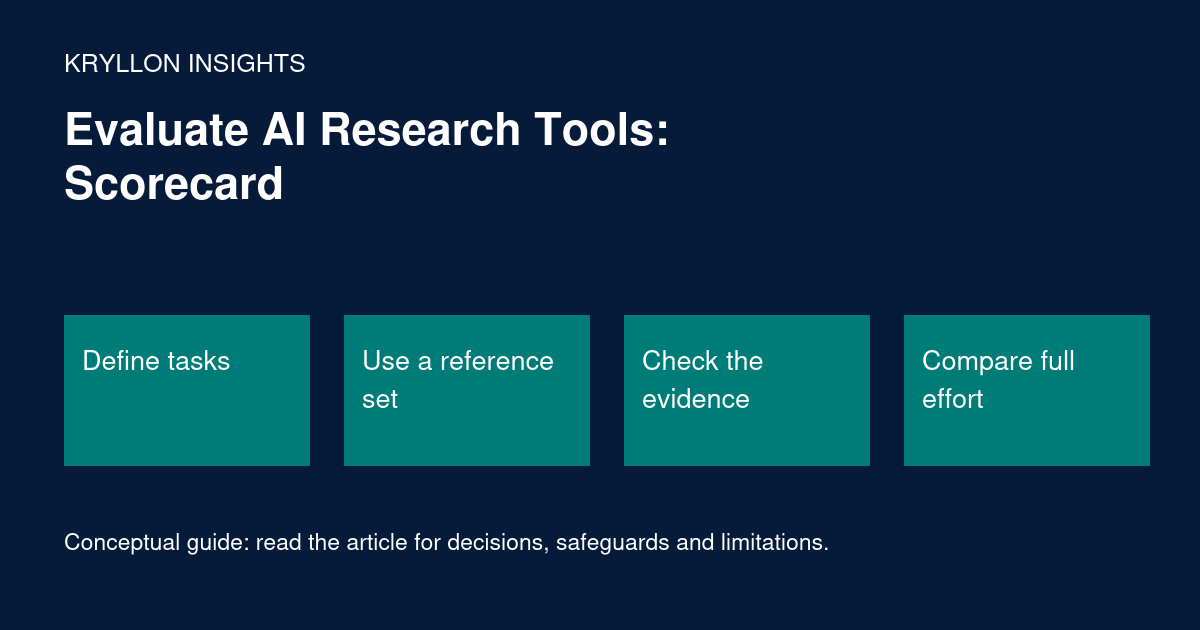
The best research tool for a task is the one whose relevant capabilities you can verify. A persuasive demonstration or a long generated bibliography cannot establish coverage, source accuracy or suitability for your research context.
This guide focuses on evaluating tools before adoption. For the end-to-end literature workflow, use our separate source-verification guide. Neither article replaces the methods required for a formal evidence review.
Define the job you are evaluating
Separate discovery, screening assistance, extraction, synthesis and writing support. A tool that generates useful search terms may be unsuitable for extracting numerical results. Assess each proposed job rather than assigning one general “research quality” score.
Record the discipline, source types, languages, dates and expected output. Ask a librarian or subject specialist whether the evaluation set reflects the sources and edge cases that matter.
Create a reference set you can inspect
Select known relevant sources, irrelevant near-matches and difficult cases. Include a corrected record, a preprint and an inaccessible full text where appropriate. Document why each was included and what successful behaviour means.
Keep a development set for adjusting the workflow and a separate check set for evaluating the final configuration. If every example was used to tune the prompt, performance may overstate how well the method handles new material.
Use six scorecard dimensions
- Source identity
- Does the reference exist, and do title, authors, venue and identifier agree?
- Coverage and omissions
- Which relevant records were found or missed within the documented reference set?
- Claim support
- Does the cited passage support the specific statement?
- Extraction quality
- Are methods, populations, results and limitations accurately represented?
- Workflow fit
- Can results be exported, checked and repeated without losing provenance?
- Information governance
- Are access, retention and data-use arrangements suitable for the actual material?
Record pass, fail or uncertain with supporting evidence. Keep critical failures as gates rather than averaging them away. A polished interface cannot compensate for fabricated sources.
Verify metadata and content separately
Crossref’s REST API documentation describes access to scholarly metadata deposited by members and trusted sources. Where applicable, Crossref records can help check bibliographic identity. They do not replace reading the source or assessing its quality, and not every research output is registered with Crossref.
A matching DOI supports identity, not the truth of a generated summary. Check the original document and publication record, including updates. A tool must distinguish what it accessed from what it inferred.
Compare the same work under comparable conditions
Use identical tasks and authorised inputs. Record the tool, plan, settings, date, queries and reviewer criteria. Where outputs vary, repeat relevant cases and inspect the pattern of failures rather than selecting the best run.
Illustrative scenario: two tools are asked to extract study populations from the same accessible papers. One produces a neat table but confuses the recruitment target with the analysed sample. The evaluator records the error and its source location. This is a hypothetical evaluation case, not a benchmark result.
Count verification effort
Measure time to an acceptable result, including source retrieval, checking and corrections. Track unsupported claims and missing caveats. Compare with the existing workflow, not only with another AI tool.
The UNESCO generative-AI guidance advocates human-centred use in education and research. Apply your institution’s current requirements to confidential manuscripts, participant data and disclosure of assistance.
Write a bounded adoption decision
State which tasks the tool passed, which remain uncertain, the conditions of use and the date for reassessment. Do not convert a small task set into a universal tool ranking. Pricing, access and features should be checked directly when you make a purchasing decision.
For team capability building, explore Research Productivity with AI and the AI Researcher Initiative. To discuss an evaluation or learning need, talk to Kryllon.
Continue learning
Editorial note: Prepared with AI assistance for Kryllon Intelligence Group. Sources reviewed on 15 October 2026. Examples are illustrative, not client results. For questions or corrections, contact Kryllon.