
By Kryllon Intelligence Group | Practical playbook | 15 October 2026
Useful AI adoption begins with a task and a quality standard. The following workflows are candidates to evaluate, not promises of revenue growth or instructions to automate customer interactions without supervision.
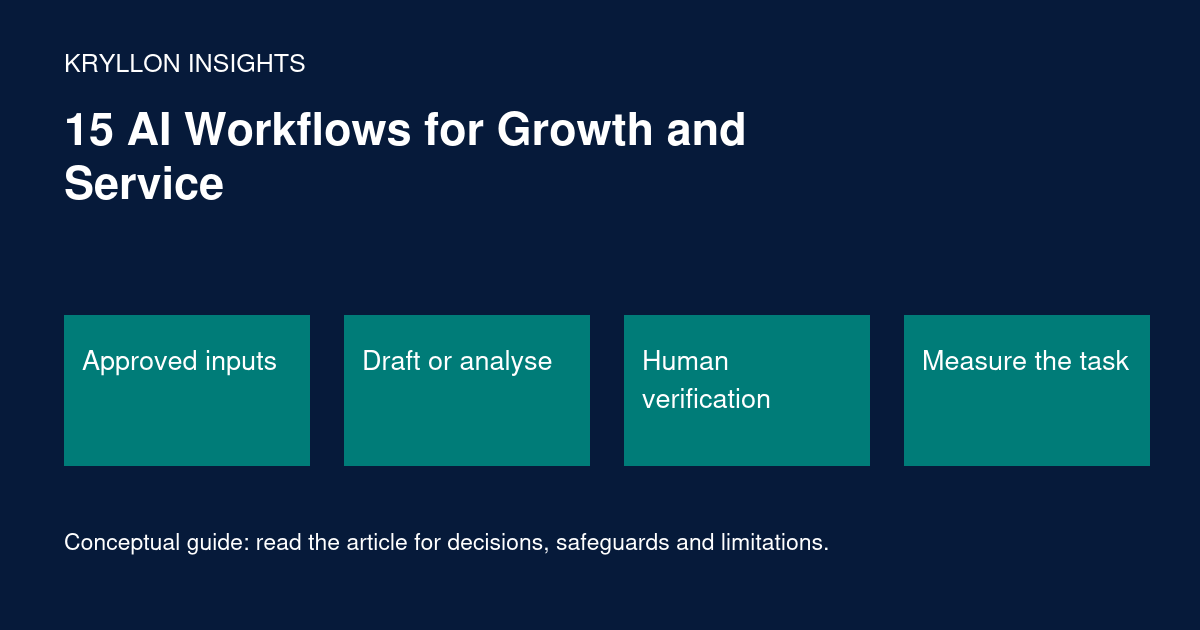
Use information you are authorised to process, keep confidential material within approved systems and verify outputs before use. Start with internal drafts and a clear escalation path. Each idea below pairs an output with a check and a measure.
Marketing: improve preparation and relevance
- Customer-language synthesis. Use consented, appropriately handled interview notes to suggest recurring themes. Check every theme against the underlying notes and preserve contrary evidence. Measure traceability and usefulness, not the number of generated insights.
- Content briefs. Turn an approved audience question and verified sources into a proposed outline. Check search intent, evidence and duplication with existing content. Measure how much revision the brief requires before acceptance.
- Message variations. Draft alternative ways to describe the same verified offer. Check that each version preserves scope and qualifications. Evaluate relevant audience response through a planned test rather than choosing the most enthusiastic wording.
- Content repurposing. Propose a shorter explanation from an approved long-form article. Check that limitations, attribution and meaning survive compression. Measure review effort and the proportion accepted without substantive correction.
- Accessibility assistance. Suggest descriptive alt text or plain-language wording. Compare it with the actual image or original meaning; obtain accessibility expertise where needed. Measure identified and resolved issues, not an unsupported compliance score.
Sales: support understanding and preparation
- Account preparation. Organise verified public information into questions for a meeting. Check source dates and distinguish facts from inference. Measure whether the brief helps the seller ask relevant questions without inventing customer needs.
- Discovery-note organisation. Structure approved meeting notes by problem, stakeholders and next decisions. Check attribution and avoid converting tentative statements into commitments. Measure missing or incorrectly assigned details.
- Proposal drafting. Assemble a draft from an approved scope, deliverables and terms. Check every commercial statement with the responsible owner. Measure time to an acceptable draft while keeping approval with the appropriate person.
- Objection analysis. Group documented objections and suggest evidence needed to address them. Verify the original wording and preserve context. Measure whether the response addresses the concern, not whether it sounds persuasive.
- Follow-up preparation. Draft a follow-up from verified notes and agreed actions. Check recipients, commitments, dates and consent before sending. Measure correction rate and clarity of the next step; do not invent urgency.
Customer service: strengthen bounded assistance
- Knowledge-base drafts. Turn approved policies into proposed help articles. Check exceptions, dates and policy ownership. Measure factual corrections and whether users can complete the intended task.
- Response drafting. Suggest an answer using approved help material. Require a reviewer to verify applicability before delivery. Measure acceptable resolution and repeat contact alongside response effort.
- Ticket classification. Suggest categories from an allowed list. Test ambiguous and high-risk requests; route uncertainty to a person. Measure classification accuracy and the cost of important misroutes.
- Service-theme analysis. Summarise appropriately handled feedback to identify questions for investigation. Check representative examples and missing groups. Measure validated issues and useful changes rather than treating theme counts as population estimates.
- Quality-review assistance. Flag possible gaps against an approved rubric. Compare flags with a qualified reviewer’s decisions. Measure missed important issues and false alarms; do not treat an automated score as a complete staff assessment.
Choose one workflow with a practical gate
Prefer a task with reliable inputs, an inspectable result and a reviewer able to detect meaningful errors. Exclude sensitive decisions and external actions from the first experiment. Record the manual baseline, review burden and conditions for stopping.
SBA market-research guidance distinguishes direct customer research from existing market information. These workflows should help organise evidence; they do not replace obtaining it.
The UK Service Manual connects performance assessment with user research. Applied here, use a relevant task outcome and feedback, not output volume alone.
Keep the commercial claims honest
Illustrative scenario: a team tests help-article drafts from an approved policy. The first review finds that a shortened answer removed an exception. The team changes its rubric and retests. This example shows why review matters; it contains no claimed performance improvement.
For growth context, explore Kryllon’s Growth Intelligence System. To select a bounded experiment for your team, discuss your workflow with Kryllon.
Continue learning
- Customer Research to Growth Experiments: An Evidence-Led Guide
- Responsible AI at Work: A Practical Pilot Checklist
Editorial note: Prepared with AI assistance for Kryllon Intelligence Group. Sources reviewed on 15 October 2026. Examples are illustrative, not client results. For questions or corrections, contact Kryllon.