
By Kryllon Intelligence Group | Educational guide | 15 October 2026
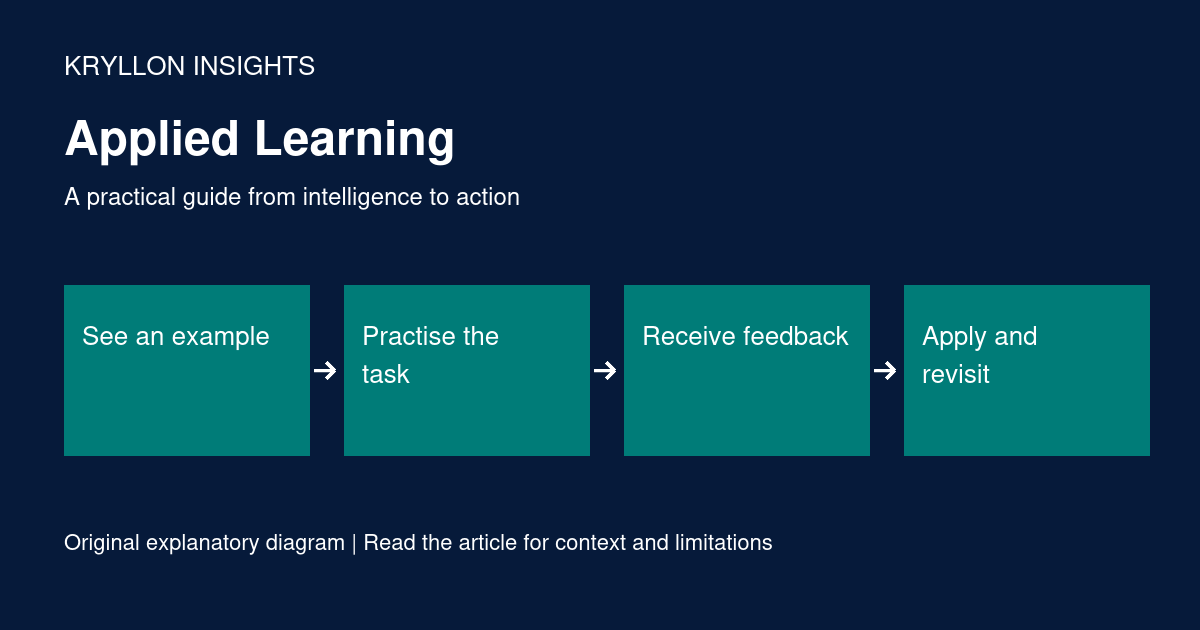
A completed course shows participation. It does not, by itself, show that someone can perform a task reliably at work. Applied learning starts with the capability people need and builds opportunities to practise, receive feedback and demonstrate that capability later.
This guide is for managers, educators and programme designers building professional learning. It offers a design method and explains where the supporting evidence needs careful interpretation.
Define the performance before the syllabus
Replace “understand responsible AI” with an observable task: “review an AI-generated summary against its sources and identify unsupported claims.” Define the context, available tools, expected quality and situations requiring escalation.
Ask an experienced practitioner to describe the difficult decisions in the task. Build the learning around those decisions rather than a catalogue of features. A task-based outcome also makes assessment more meaningful: the learner must produce or do something that can be reviewed.
Use research-informed learning activities
The U.S. Institute of Education Sciences practice guide on organising instruction and study recommends spacing learning, alternating worked examples with problem solving, combining graphics and explanations, retrieval through quizzes and deep explanatory questions. Its recommendations have different evidence ratings and come from educational settings. Applying them to workplace training is a design adaptation, not proof that a particular workshop will improve job performance.
For practical design, show a worked example, ask learners to solve a related problem, provide specific feedback and return to the skill after a delay. Use retrieval questions that require an answer from memory before revealing guidance. Keep practice supportive; the aim is to expose gaps while they can still be addressed.
Build a practice cycle around a real task
- Model: show an example and explain the decisions behind it.
- Attempt: ask learners to complete a similar task with appropriate support.
- Review: compare the attempt with explicit quality criteria.
- Revise: let learners correct the work and explain the change.
- Transfer: apply the skill to a different, relevant situation.
- Revisit: check the skill later and target remaining difficulties.
Reduce support gradually as learners become more capable. If an exercise introduces too many unfamiliar elements at once, difficulty may reflect confusing instructions rather than the skill you intend to assess.
Make feedback specific enough to act on
“Good work” does not tell a learner what to repeat. “You checked the quoted figure against the original table, but missed the date qualification” identifies both a successful action and a next step.
Use a short rubric with criteria such as accuracy, evidence use, reasoning and appropriate escalation. Define what acceptable work looks like in each criterion. Calibrate reviewers using the same example so that feedback does not depend entirely on individual preferences.
Illustrative scenario: learners receive a synthetic report and an AI-generated summary containing unsupported statements. They mark each claim, find supporting passages, revise the summary and explain which statements cannot be verified. Later, they repeat the task with a different report. No real confidential information or client result is involved.
Measure more than satisfaction
Collect participant feedback to improve the experience, but assess learning through task performance. Where feasible, compare an initial attempt, an end-of-programme task and a later task in the work context. Use comparable difficulty and consistent criteria.
Record whether learners can access the tools, time and managerial support needed to use the skill. If capability is demonstrated in training but rarely used at work, the obstacle may be the environment rather than the teaching alone.
Do not attribute business results solely to training when staffing, systems or incentives changed at the same time. Describe the evidence you actually collected and the alternative explanations that remain.
Use AI without outsourcing the learning
AI can help propose practice questions or alternative explanations, but someone with relevant expertise must check their accuracy and suitability. Avoid allowing a tool to complete the exact reasoning the learner is supposed to practise without a deliberate pedagogical reason.
UNESCO’s guidance on generative AI in education and research advocates a human-centred approach and validation of appropriate educational use. For sensitive or regulated learning contexts, obtain the relevant subject-matter review before using scenarios or automated feedback.
Plan one usable learning intervention
Choose one performance gap, one authentic task and one assessment rubric. Schedule practice and a later follow-up before expanding the programme. Provide accessible materials and alternative participation routes where needed.
Explore Kryllon Academy or Custom Learning Programs for related scope. If you are designing learning around a specific workplace challenge, discuss your programme with Kryllon.
Continue learning
- AI-Assisted Literature Reviews: Verify Every Source
- Customer Research to Growth Experiments: An Evidence-Led Guide
Editorial note: Prepared with AI assistance for Kryllon Intelligence Group. Sources checked on 15 October 2026. Illustrative examples are not client results. For questions or corrections, contact Kryllon.