
By Kryllon Intelligence Group | Strategic briefing | 15 October 2026
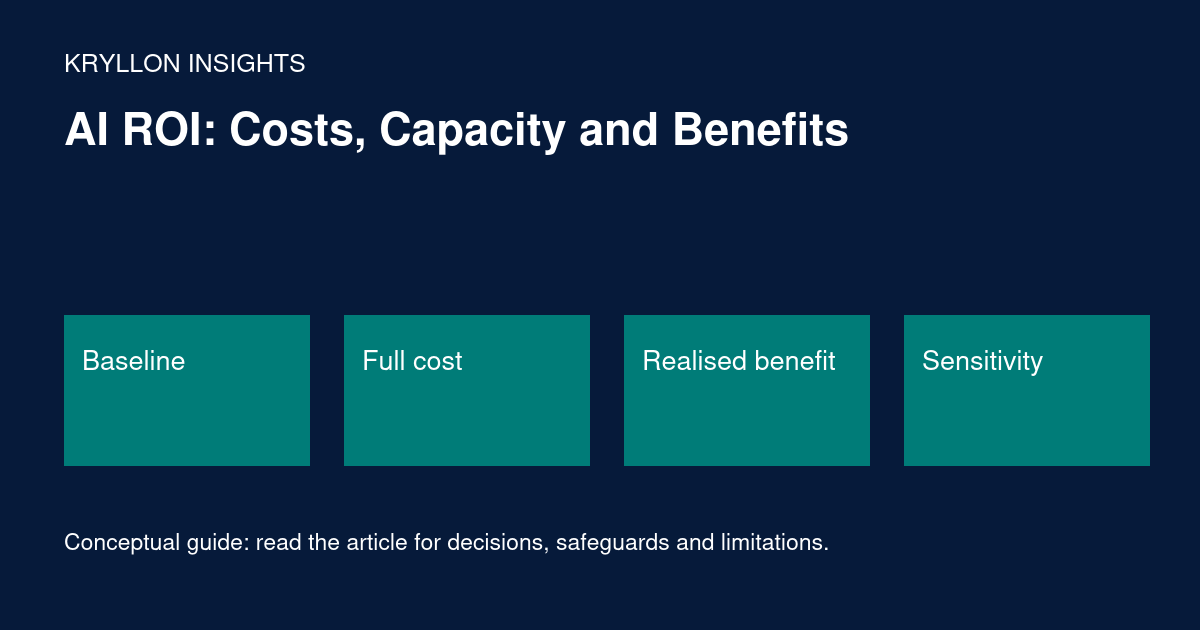
An AI return-on-investment estimate is a model of assumptions. It becomes useful when the team can inspect those assumptions, distinguish capacity from cash and compare alternatives on the same basis.
This educational worksheet supports business planning. It does not predict a specific organisation’s return or replace professional financial analysis for a material investment.
Define the unit of work and the comparison
Choose a completed, acceptable task: a reviewed report, resolved inquiry or validated record. Use the same definition for the current process and the proposed process. Record volume, complexity, quality and the period observed.
The UK Service Manual’s benefits guidance emphasises a baseline and an economic model of costs and benefits. Its context is government services. We adapt that planning principle here, not its specific examples or assumptions as business forecasts.
Count the full cost
- Set-up: process discovery, configuration, integration, testing and training.
- Recurring technology: subscriptions, usage, hosting, monitoring and support.
- Human effort: input preparation, review, corrections and escalations.
- Change: retesting, updates, staff turnover and switching costs.
- Failure: remediation and operational disruption, with important risks assessed separately.
Check current vendor pricing for your expected volume and plan. Include a usage range rather than assuming every task costs the same. A cheap generated answer can still produce an expensive completed task.
Separate three types of benefit
Capacity released is staff time available for other work. Cashable savings require a change in actual expenditure. Additional contribution requires additional demand, fulfilment capacity and revenue beyond the extra cost of serving it.
Do not value the same hour both as avoided labour expense and as capacity generating extra revenue. Record quality improvements separately when there is no defensible monetary estimate.
A transparent illustrative calculation
All figures below are hypothetical planning inputs in Canadian dollars, not Kryllon results, vendor prices or recommended targets. Suppose a team completes 100 comparable tasks each month. The current task takes 30 minutes. The AI-assisted task takes 12 minutes to prepare and generate, plus 10 minutes to review and correct.
- Current effort: 100 × 30 ÷ 60 = 50 hours per month.
- Proposed effort: 100 × 22 ÷ 60 = approximately 36.7 hours.
- Capacity released: approximately 13.3 hours.
- At an assumed $40 per hour: approximately $533 of capacity value.
If recurring incremental costs are $250, the arithmetic leaves approximately $283 of monthly capacity value after those costs. That is not automatically cash profit. If no expenditure falls and the capacity is not productively redeployed, cashable benefit may be zero.
Suppose set-up costs $2,000. A simple payback calculation would divide that amount by a positive monthly net realised benefit. It is inappropriate to claim a cash payback using the $283 above unless those benefits are actually realised in cash on a comparable basis.
Use formulas with explicit boundaries
For a chosen evaluation period, simple ROI can be expressed as: (incremental realised benefits − incremental costs) ÷ incremental costs × 100, where costs are greater than zero. Include set-up and recurring costs for that period. Keep the units and time horizon consistent.
Simple ROI omits the timing of cash flows and may be insufficient for a large or long-lived investment. Material decisions may require discounting, tax treatment, financing considerations and specialist review. Do not hide unquantified safety or operational risks inside an optimistic percentage.
Challenge the assumptions
Test a conservative, central and optimistic case. Vary task volume, review time, exception rate and actual benefit realisation. Ask what must be true for the proposal to outperform improving the existing process without AI.
At the illustrative volume, if review and correction grow enough that total effort returns to 30 minutes, the assumed time benefit disappears while technology costs remain. That possibility should be visible before approval.
Use a decision worksheet
- Observed baseline
- Volume, comparable case definition, time, quality and data source.
- Cost assumptions
- Set-up, recurring use, human effort and changes.
- Benefit mechanism
- Which expenditure falls or which additional contribution is achievable?
- Decision threshold
- What evidence justifies continuation, revision or stopping?
Compare the estimate with pilot evidence and record why it changed. For support connecting the business decision to delivery, explore Strategy and Transformation Advisory or discuss your challenge with Kryllon.
Continue learning
- From Business Strategy to Execution: Build a Decision Brief
- How to Implement AI in a Small Business: A Practical Roadmap
Editorial note: Prepared with AI assistance for Kryllon Intelligence Group. Sources reviewed on 15 October 2026. Examples are illustrative, not client results. For questions or corrections, contact Kryllon.