
By Kryllon Intelligence Group | Educational guide | 15 October 2026
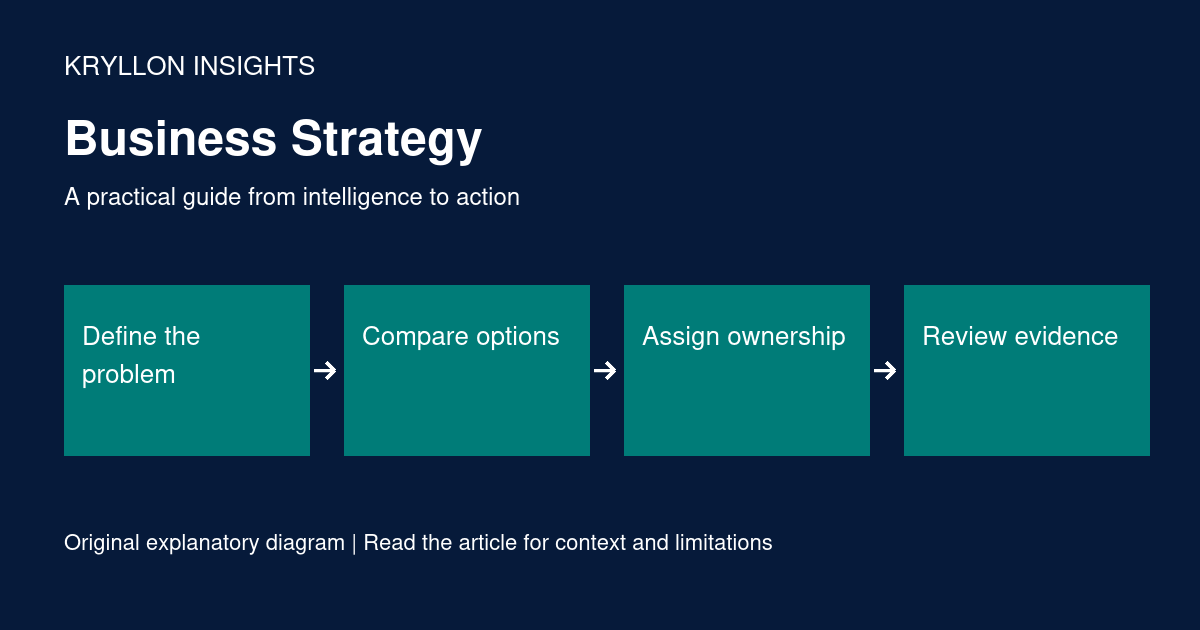
A strategy becomes actionable when people know which decision to make, why it matters, who owns it and what evidence will show whether it worked. A long list of initiatives rarely answers those questions on its own.
This guide offers a decision brief for leaders, founders and teams facing competing priorities. The template is an editorial planning aid, not a validated maturity model or a guarantee of business improvement.
Separate the problem from the proposed solution
“We need a new platform” is a proposed solution. “Customers repeatedly provide the same information because teams cannot see prior submissions” describes a problem that can be investigated. Begin with the affected people, the task they are trying to complete and the observable friction.
Gather examples from the work itself. Interview the people handling the task, examine a sample of recent cases and follow the handoffs. Distinguish recorded observations from explanations that still need testing. If evidence is incomplete, state what you do not yet know.
Write the outcome before choosing the initiative
Describe the change you want in user or operational terms. A useful outcome might be fewer incomplete handoffs while maintaining accuracy. Installing software is an activity; reducing avoidable rework is an outcome.
The UK Government’s Service Manual recommends combining performance metrics with user research when assessing service performance. That is public-service guidance; the approach here adapts the principle to an organisational decision rather than claiming every government metric fits every business.
Use this decision-brief template
- Decision required
- What must be approved, deferred or rejected, and by whom?
- Problem and evidence
- Which observations establish the issue? Which assumptions remain uncertain?
- Desired outcome
- What should change for customers, staff or the organisation?
- Alternatives
- What could you do, including improving the current process or doing nothing for now?
- Constraints and dependencies
- What limits budget, capacity, access, timing or implementation?
- Owner and contributors
- Who is accountable, and whose expertise or approval is needed?
- Measures and review
- What is the baseline, what will you monitor and when will you reconsider?
Keep the brief short enough that stakeholders can challenge it. Link to supporting evidence rather than burying uncertainties in a presentation appendix.
Compare alternatives on the same basis
Avoid comparing a fully costed current process with an optimistic description of a new system. Include implementation, training, support, review and switching effort for every option. Identify whether the organisation can reverse the decision and what would be lost if it fails.
Use a simple comparison: expected benefit, evidence strength, effort, dependencies, foreseeable harm and reversibility. Do not total arbitrary scores and treat the result as objective truth. A serious unresolved dependency can outweigh several attractive features.
Illustrative scenario: a service team suspects that a new customer portal will reduce delays. Its brief compares a portal, a revised intake form and a clearer staff handoff. An initial review finds that missing ownership, rather than missing technology, explains several delayed cases. The team tests the handoff before committing to a larger build. This example illustrates decision logic; it reports no measured result.
Define measures that cannot hide the trade-off
Choose an outcome measure, a process measure and a safeguard. For a handoff change, those might be completed cases without rework, time between intake and assignment, and the rate of incorrect assignments. Define each numerator, denominator, time window and source.
Record missing data and changes in case complexity. If performance improves after a change, describe it as an observed association unless the evaluation design supports a causal conclusion. Seasonality, staffing and different customer needs may also affect results.
Turn ownership into an operating rhythm
Name one accountable owner with the authority and time to act. Contributors should know which decisions they support and which they can make independently. Agree where blockers are recorded and how unresolved conflicts are escalated.
At each review, ask what changed, what the evidence supports, which assumption failed and what decision is now required. Meetings should lead to an explicit action, further investigation, continuation or stop decision.
Start with one consequential decision
Select a priority that currently generates repeated discussion without a clear next action. Complete the brief, gather contrary evidence and review it with the people doing the work.
Kryllon’s Transformation Scorecard introduces related capability themes. Explore Strategy and Transformation Advisory for the engagement scope, or discuss your challenge with Kryllon if you want help defining the decision and implementation path.
Continue learning
- Customer Research to Growth Experiments: An Evidence-Led Guide
- Responsible AI at Work: A Practical Pilot Checklist
Editorial note: Prepared with AI assistance for Kryllon Intelligence Group. Sources checked on 15 October 2026. Illustrative examples are not client results. For questions or corrections, contact Kryllon.