
By Kryllon Intelligence Group | Kryllon Explains | 15 October 2026
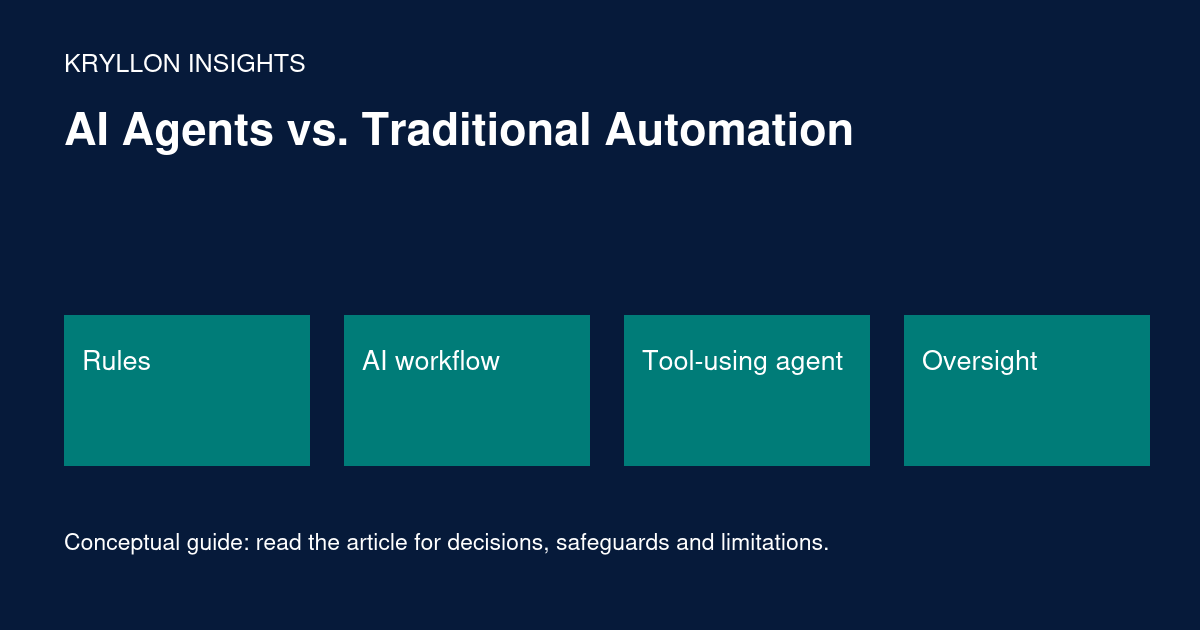
An AI agent is not simply a chatbot with a more ambitious name. The practical distinction is how much control software gives a model over the next action. That affects flexibility, predictability, cost and the consequences of a mistake.
This explainer is a strategic briefing, not a product announcement or a prediction of how quickly jobs will change. It uses architectural distinctions to help teams ask better questions about a proposed system.
Three approaches in plain language
Rules-based automation follows explicit conditions: when a validated form arrives, create a record and notify the assigned team. Rules can be sophisticated, but the permitted paths are designed in advance.
An AI-assisted workflow introduces a model into a defined process. For example, a model suggests a category, software validates it against an allowed list, and a person reviews ambiguous cases.
A tool-using agent can choose actions while pursuing a goal. It may inspect information, decide what to do next, use an available tool and evaluate the result before continuing. The word “agent” is used inconsistently, so ask which choices the model actually controls.
In Building effective agents, published in December 2024, Anthropic distinguishes predefined workflows from systems in which models dynamically direct their processes and tools. The article now cautions that tooling has changed since publication. We use that conceptual distinction here, not its older product landscape as a current buying guide.
Match the approach to the uncertainty
If the task has stable inputs, clear rules and few exceptions, begin by considering ordinary software or automation. If interpreting language is necessary but the stages are predictable, consider a bounded AI workflow. If the route genuinely depends on what the system discovers, an agent may be worth testing.
Complexity is a cost. More model calls, tools and decision points create more opportunities for unexpected behaviour and more evidence to inspect. The appropriate choice is the least complex design that meets the task’s requirements.
Compare the same task, not different demonstrations
Illustrative scenario: a support team wants to handle recurring questions. A rules-based system can route requests using known fields. An AI workflow can draft an answer from approved material for review. An agent might investigate several systems, but would need tightly bounded access and explicit approval before changing an account. These are design alternatives, not verified results.
- Predictability: can you explain the permitted paths and failure behaviour?
- Flexibility: which exceptions actually require a model’s judgement?
- Review: can someone inspect the evidence and action history?
- Cost: what happens to usage, latency and support effort under difficult cases?
- Recovery: can a failed action be detected, stopped and reversed?
Separate permission to read from permission to act
Reading an approved document is different from sending a message, changing a record or initiating a transaction. Design tools with the narrowest useful capabilities. Do not grant a general-purpose tool when a specific read-only function will do.
OWASP’s excessive-agency guidance describes risks from unnecessary functionality, permissions and autonomy. Its mitigation principles include limiting capabilities and requiring appropriate human approval. Controls must be enforced by the application; a prompt asking the model to behave carefully is not an access-control system.
Evaluate behaviour across a journey
Test the final outcome and the route taken. An agent that arrives at a plausible answer after accessing prohibited information has not passed. Include time limits, tool failures, missing records and situations requiring escalation.
Log actions in a privacy-conscious way, impose budget and iteration limits, and retain a manual fallback. Recheck material changes to models, tools and permissions. Passing a small test set does not establish reliability in every future context.
Kryllon perspective
Start with a bounded workflow when you can define the path. Test an agent only when flexible action selection addresses a real need and the organisation can evaluate and control it. Defer deployment if the team cannot explain the permissions, detect important errors or recover from an unwanted action.
Explore Kryllon Labs for applied-technology context. To frame a practical automation question before selecting a platform, discuss your workflow with Kryllon.
Continue learning
- How to Implement AI in a Small Business: A Practical Roadmap
- Kryllon Explains: Prompt Injection and Why Business Teams Should Care
Editorial note: Prepared with AI assistance for Kryllon Intelligence Group. Sources reviewed on 15 October 2026. Examples are illustrative, not client results. For questions or corrections, contact Kryllon.