
By Kryllon Intelligence Group | Educational guide | 15 October 2026
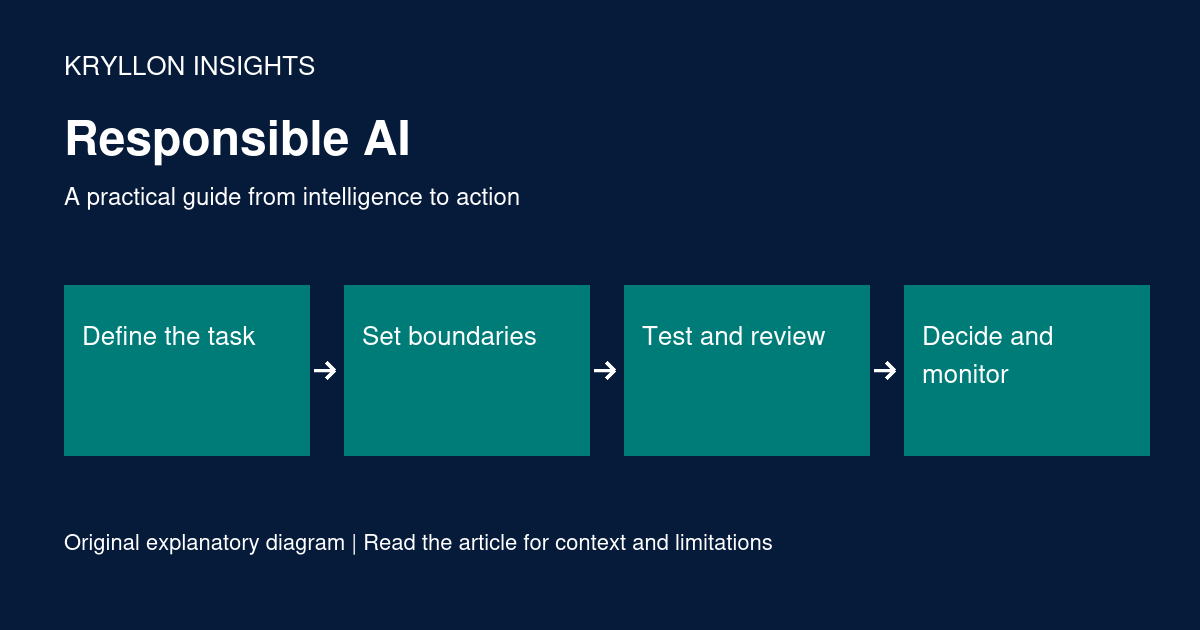
A responsible AI pilot starts with a specific task, an accountable owner and a way to discover when the system is wrong. Buying a tool or writing a general AI policy does not establish whether a particular workflow is useful or safe.
This guide helps managers and professional teams design a bounded pilot. It is educational guidance, not a compliance certification or a substitute for specialist review of high-impact uses.
Start with the decision, not the software
Describe the current task in one sentence: who performs it, which inputs they use, what they produce and who relies on the result. Record the current time, common errors and review requirements before introducing AI. Choose a task where mistakes can be detected and corrected before they affect anyone.
Illustrative scenario: a team wants help drafting summaries of approved public reports. The pilot produces internal drafts only. A named reviewer checks every material claim against the source report before anything is shared. This is a proposed example, not a Kryllon client result.
Use governance throughout the pilot
The NIST AI RMF 1.0 Core describes Govern, Map, Measure and Manage as connected functions, not a fixed sequence or a certification checklist. Governance should inform the work throughout. NIST notes that a revision of RMF 1.0 is in progress; this article refers specifically to the published 1.0 Core.
- Govern: assign ownership, decision authority and escalation responsibilities.
- Map: describe the context, affected people and consequences of errors.
- Measure: test performance and risks using representative cases.
- Manage: act on findings, monitor changes and keep a fallback.
These summaries explain the framework. The pilot worksheet below is an editorial implementation aid; completing it does not establish conformity with the full framework.
Write a one-page pilot agreement
- Purpose: name the task and the problem the pilot should address.
- Boundary: state permitted inputs, prohibited inputs and outputs that cannot be used without approval.
- People: name the operator, reviewer, owner and person who can stop the pilot.
- Evidence: specify test cases, quality criteria and the comparison workflow.
- Controls: document access, review, logging, retention and fallback arrangements.
- Decision: set a review date and conditions for proceeding, revising or stopping.
Confirm what the selected service does with submitted data under the actual plan and settings. Do not infer privacy protections from a product label. Use public, synthetic or appropriately authorised material during initial testing. Never place confidential information in a tool merely because it is convenient.
Test failure cases as deliberately as normal cases
NIST’s Generative AI Profile, AI 600-1 describes confabulation: confidently presented content that is false or erroneous. Fluency is therefore insufficient evidence of accuracy.
Include missing information, contradictory sources, ambiguous instructions and requests outside the permitted scope. Check whether the system admits uncertainty, invents references or quietly drops qualifications. Where documents are supplied, treat their instructions as untrusted content and restrict any connected tools to the access required for the task.
Keep a test log with the input category, tool or model version, observed output, error type, reviewer decision and corrective action. Avoid storing sensitive inputs unnecessarily. Retest after material changes to the model, prompt, connected data or workflow.
Make human review an executable responsibility
“A human will check it” is incomplete. State what the reviewer must check, which evidence they can access and what they should do when the source is missing. Budget review time. A reviewer who cannot understand the subject or inspect the evidence cannot provide meaningful assurance simply by approving a screen.
For the report-summary example, the reviewer checks numbers, names, dates, source attribution and omitted caveats. Unsupported statements are removed or rewritten. The original manual process remains available when the tool fails.
Decide using quality and total effort
Compare the pilot with the baseline using the same definition of a completed, acceptable task. Count preparation, generation, checking and correction time. Track critical errors separately; a faster average cannot compensate for an unacceptable failure.
Proceed only when the documented criteria are met and the responsible owner accepts the remaining risks. Revise when the task is useful but controls or quality need work. Stop when important errors cannot be detected reliably or the required safeguards are unavailable.
Your next step
Choose one bounded task and complete the pilot agreement before selecting a deployment date. For broader context, read Kryllon’s AI Adoption Readiness Guide or explore Responsible AI for Professionals. If you need help framing the task and safeguards, discuss your challenge with Kryllon.
Continue learning
- From Business Strategy to Execution: Build a Decision Brief
- AI-Assisted Literature Reviews: Verify Every Source
Editorial note: Prepared with AI assistance for Kryllon Intelligence Group. Sources checked on 15 October 2026. Illustrative examples are not client results. For questions or corrections, contact Kryllon.