
By Kryllon Intelligence Group | Educational guide | 15 October 2026
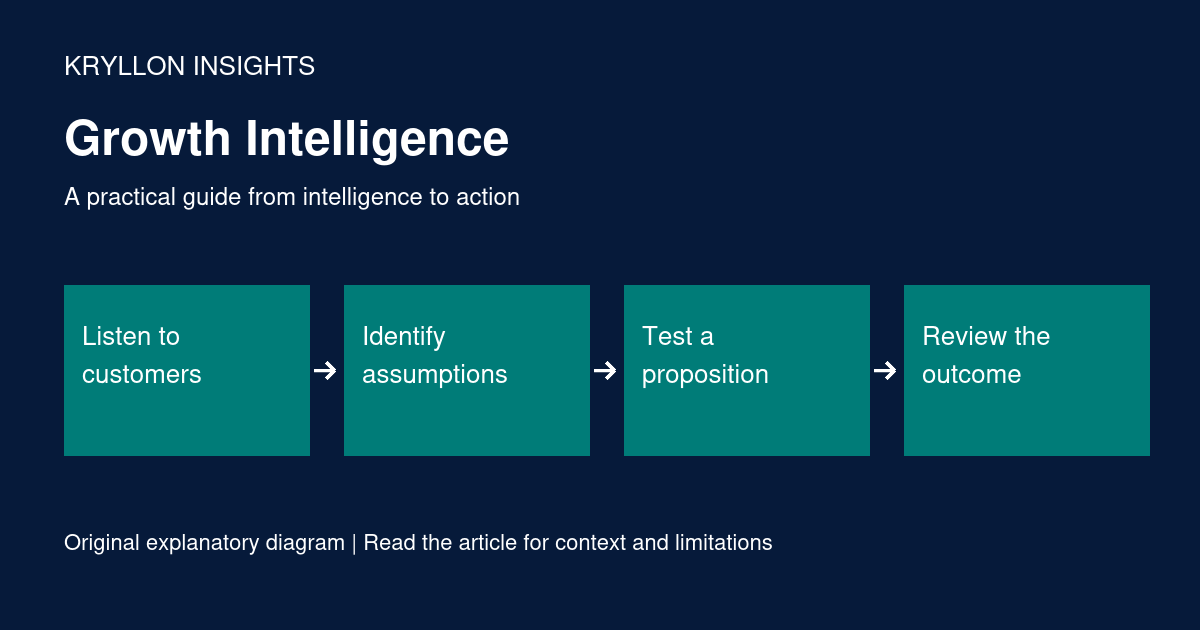
Before increasing marketing spend, identify which uncertainty is preventing a good decision. You may not know who needs the offer, how they describe the problem, which alternatives they use or whether the proposed next step feels worthwhile.
Customer research and growth experiments answer different questions. Research helps explain context and needs. An experiment tests a defined change under specific conditions. Using both can improve the quality of a decision, but neither guarantees demand or revenue.
Begin with a decision you can change
Write a question such as: “Should we position this workshop around practical workflow design or introductory AI concepts for operations managers?” That is more useful than a broad instruction to understand the market.
The U.S. Small Business Administration’s market-research guidance distinguishes existing market information from direct research with customers. It covers demand, alternatives, market conditions and methods such as interviews and surveys. Use its general planning principles while selecting data relevant to your own geography and audience.
Ask about actual behaviour
Recruit people who plausibly face the problem, including people who did not purchase or stopped using an alternative. Explain the research purpose, obtain appropriate consent and avoid collecting unnecessary personal information.
Useful interview prompts include:
- Tell me about the last time this problem occurred.
- What triggered your search for a solution?
- What did you try, and what made that difficult?
- Who else influenced the decision?
- What did you use instead, including doing nothing?
- What evidence would you need before changing your approach?
Avoid leading questions such as “Would our innovative solution help?” Positive reactions in an interview are not purchase commitments. Keep participants’ words separate from the team’s interpretation.
Build an evidence table
For each theme, record the observation, source, context, contradictory evidence and implication for the decision. Mark whether a statement is a direct quotation, paraphrase, observed behaviour or analyst inference.
A recurring theme in a small interview set is a useful hypothesis, not a population estimate. Do not convert a handful of conversations into a market-wide percentage. Check whether participants share circumstances that explain the pattern, and seek evidence from different situations.
Translate a theme into a testable proposition
Illustrative scenario: interviews suggest that managers struggle to identify an appropriate first AI workflow. A team proposes a workshop focused on selecting and testing one bounded task. The proposed experiment compares that proposition with its current workshop description. This is a hypothetical example, not a Kryllon campaign result.
Specify the audience, proposition, channel, next step and observation window. Record what would count as evidence against the idea. Do not change the audience, headline, price and call to action simultaneously if your goal is to understand which change mattered.
Choose a metric that matches the decision
Impressions show exposure. Clicks show a response to a link. Neither establishes qualified demand. A useful primary outcome might be the proportion of eligible visitors who request relevant information, supported by an assessment of whether those inquiries fit the intended audience.
The UK Service Manual’s guidance on performance metrics connects measurement with a service’s purpose and hypotheses. Applied here, the lesson is to define what you are trying to learn before selecting a dashboard number.
Write the denominator explicitly. “Six inquiries” means little without knowing the exposure, audience and period. Include safeguards such as misleading expectations, complaints, lead quality and staff follow-up effort.
Respect the limits of the experiment
If you can randomise eligible visitors and keep other conditions comparable, you may be able to estimate the effect of the tested variation. With a small audience or sequential campaigns, time, channel and audience differences can confound the comparison.
Do not declare a winner from a few clicks or repeatedly stop the test when a result looks favourable. Plan the analysis, duration and required precision with appropriate expertise. When evidence is too limited, report uncertainty and use the result to design the next investigation.
Keep a decision log
Record the question, supporting research, tested change, method, result, limitations and decision. Preserve failed tests as well as promising ones. Otherwise, the organisation may repeat unsuccessful ideas while remembering only successes.
Your first practical step is to replace one broad growth assumption with a question that customer evidence can challenge. For related context, explore Kryllon Growth and the Growth Intelligence System. To discuss a research or experiment design challenge, talk to Kryllon.
Continue learning
- Design Applied Learning That Transfers to Work
- From Business Strategy to Execution: Build a Decision Brief
Editorial note: Prepared with AI assistance for Kryllon Intelligence Group. Sources checked on 15 October 2026. Illustrative examples are not client results. For questions or corrections, contact Kryllon.