
By Kryllon Intelligence Group | Practical playbook | 15 October 2026
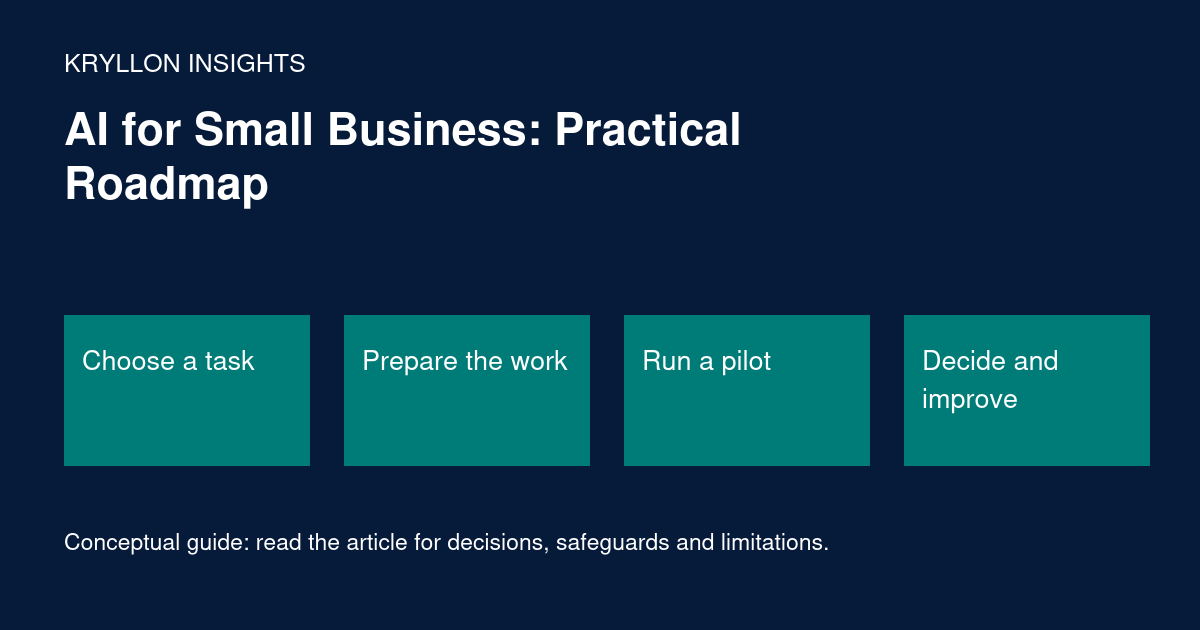
Implementing AI in a small business is a sequence of business decisions: which task needs improvement, what information is safe to use, how outputs will be checked and whether the result justifies the effort. A useful first deployment can be small. It needs a clear owner and an honest comparison with the current way of working.
This roadmap is for owners and managers planning their first bounded AI use case. It is an educational planning aid, not a compliance checklist. It does not assume a particular vendor, budget or level of technical expertise.
Define a business problem you can observe
Start with repeated friction: staff rewriting similar internal documents, customers receiving inconsistent explanations or a team spending time finding approved information. Record examples before prescribing a tool. Ask the people doing the task which part is difficult and what an acceptable result looks like.
Map the task from input to approved output. Include exceptions and handoffs. If nobody can explain the current process, documenting it may be the most useful first intervention.
Build a shortlist of tasks, then apply exclusion gates
For each candidate, record frequency, effort, available evidence, information sensitivity and the consequence of an error. Prefer a first task whose output can be reviewed before it affects a customer or changes a business record.
- Can you define an acceptable result and inspect the evidence behind it?
- Do you have permission to use the inputs in the selected service?
- Can a reviewer detect a consequential error?
- Can you keep a manual fallback?
- Is the task stable enough to compare before and after?
If an answer is no, redesign or defer the candidate. Do not allow an attractive time-saving estimate to override a serious unresolved risk. Avoid a first pilot that autonomously makes sensitive employment, health, legal or financial decisions.
Choose the simplest suitable approach
A reusable template may solve the problem. A rule-based automation may be sufficient when inputs and decisions are predictable. A language model may help where drafting or interpreting language is central. Tool-using agents introduce additional operational decisions because they can act, not only produce text.
Compare solutions using the same task and the same quality criteria. Check access controls, data handling, retention, export, integration requirements, accessibility, support and total cost under the actual plan you would buy. Product features and terms change; confirm them directly before committing.
Prepare a small, representative evaluation set
Include straightforward examples, incomplete inputs and situations that should be escalated. Write the expected behaviour before examining the model’s answer. Separate critical errors from minor style issues.
The NIST AI RMF 1.0 Core treats governance, context, measurement and risk management as connected activities across the lifecycle. This roadmap adapts that risk-aware principle; it does not establish conformity with the entire framework.
Run a bounded pilot with a named reviewer
State the permitted task, input boundaries, reviewer responsibilities, stop conditions and decision date. Start with public, synthetic or appropriately authorised information. Keep the original process available.
Illustrative scenario: a small service business tests AI-assisted drafts of answers to common questions using an approved public FAQ. Staff check each answer against that FAQ before sending it. The pilot excludes customer records and account changes. This is an example of scope, not a report of a Kryllon client deployment.
Record both successes and failures. When the system lacks evidence, an explicit request for human help is preferable to an unsupported answer. Review privacy and security arrangements with the appropriate specialists where the context requires them.
Measure the whole workflow
Count preparation, generation, review, correction and maintenance. Compare tasks of similar complexity. Track acceptable completions, critical errors and staff effort, alongside the result the business actually values.
Time released is capacity. It becomes a cash saving only if an actual expenditure changes; it becomes revenue only if additional demand can be served and converted. Use conservative scenarios and keep assumptions visible.
Decide whether to expand
Proceed when the agreed criteria are met and the owner accepts the remaining risks. Revise the task or controls when the benefit is plausible but the evidence is incomplete. Stop when important errors cannot be detected or the review burden outweighs the value.
Before expansion, document the working method, train the people involved and assign responsibility for changes. Retest after a significant model, prompt, data or process change. A successful demonstration is not evidence of reliable performance across every situation.
Your adoption-plan worksheet
- Problem and task
- What is difficult today, for whom, and how often?
- Baseline and outcome
- What is the current quality and effort? What would justify change?
- Information and safeguards
- What is permitted, who reviews, and what must remain out of scope?
- Pilot decision
- Who decides, on which evidence, and when will the decision be revisited?
For help identifying readiness gaps, explore Kryllon’s AI Readiness Assessment and readiness guide. To discuss your particular workflow, talk to Kryllon.
Continue learning
- Responsible AI at Work: A Practical Pilot Checklist
- How to Estimate AI ROI Without Inflating the Benefits
Editorial note: Prepared with AI assistance for Kryllon Intelligence Group. Sources reviewed on 15 October 2026. Examples are illustrative, not client results. For questions or corrections, contact Kryllon.