
By Kryllon Intelligence Group | Educational guide | 15 October 2026
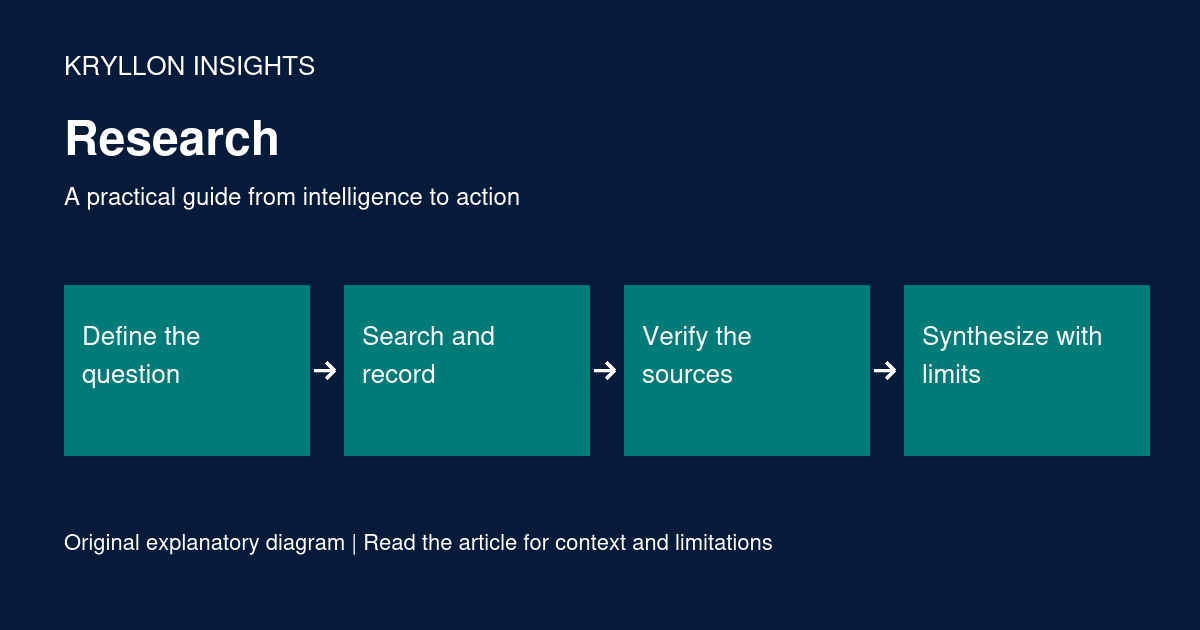
AI can help brainstorm search terms, organise notes or suggest ways to structure a synthesis. A generated reference list, however, is not a verified evidence base. Each source and each claim must be checked before it supports a research conclusion.
This guide describes a practical, auditable workflow for students, researchers and professional teams. It does not replace a librarian, supervisor, subject specialist or the requirements of a formal evidence-review method.
Decide what kind of review you are doing
An exploratory reading exercise, a narrative review and a systematic review serve different purposes and require different methods. Do not label an AI-assisted summary “systematic” because it contains many references.
Write the research question, scope, intended use and review type. Define inclusion and exclusion criteria before screening. For a formal review, follow an appropriate method and reporting standard and obtain methodological support where needed. A useful informal workflow is not automatically a complete formal review.
Use AI to develop candidates, then search real databases
Ask for synonyms, related concepts and possible search structures. Check those suggestions against the terminology used in the field. Search appropriate bibliographic databases or other authoritative sources directly, following their own syntax and access rules.
Record the database, exact query, filters and search date. Keep exported records where permitted. Document supplementary searches and why they were added. Another person should be able to understand how the source set was assembled, even if database contents change later.
Verify that every reference exists
NIST’s Generative AI Profile explains that generative systems can confidently present false content. In a research workflow, treat generated citations as unverified candidates until checked against authoritative records.
- Match the title, authors, publication venue and year.
- Resolve the DOI or stable identifier and confirm that it points to the same work.
- Read the original source, not only an AI summary or search snippet.
- Check the publication record for corrections, retractions or updated versions.
- Separate preprints from peer-reviewed publications and describe their status accurately.
A working link does not establish that a paper supports the attached claim. Verification has two parts: confirming the source’s identity and checking what it actually says.
Build an evidence matrix
For each included source, record the citation, study question, design, population or setting, relevant finding, limitations and the location of supporting text. Add your assessment separately from the authors’ interpretation.
Use explicit labels for direct quotations, paraphrases and reviewer inference. Capture page, section or table references where available. Keep enough context to avoid turning a qualified statement into a universal conclusion.
Illustrative scenario: an AI summary says a learning intervention “works for all professionals.” The original study examined one student group using a particular assessment. The evidence matrix records that narrower setting and outcome. The synthesis then describes what was observed and explains why transfer to another population remains uncertain. This is a hypothetical checking example.
Use AI extraction cautiously
If permitted, supply a source you have lawfully accessed and request a structured extraction with supporting passages. Check the extraction against the document. Long documents, complex tables and supplementary files can produce omissions or mistaken associations.
Do not assume a model has read a paywalled article because it recognises the title. When full text is unavailable, record that limitation and seek legitimate access or specialist help. Do not fill missing methods or results with plausible guesses.
Synthesize findings without overstating them
Group evidence by question and method rather than counting favourable conclusions. Consider differences in study design, context and limitations. Explain contradictory findings. Do not treat an association as a causal effect or combine incompatible measures into an invented summary statistic.
Make the evidence trail visible: which source supports each substantive statement, what remains uncertain and which conclusions are your interpretation. Use AI to challenge structure or suggest missing questions, while retaining responsibility for the final analysis.
Document AI use and protect research material
UNESCO’s guidance supports human-centred use of generative AI in education and research, including attention to privacy and ethical validation. Follow the specific policies of your institution, funder, journal and collaborators.
Record the tool, version where available, date, purpose and verification performed. Disclose AI assistance as required by the relevant policy. Do not upload participant data, confidential manuscripts or restricted material without appropriate authorisation and safeguards.
Start with a small verified evidence set
Choose a focused question, document the search and complete the matrix for the first relevant sources. Resolve uncertainty before writing a confident conclusion.
For related learning, explore Research Productivity with AI and the AI Researcher Initiative. To discuss a research-workflow learning need, talk to Kryllon.
Continue learning
Editorial note: Prepared with AI assistance for Kryllon Intelligence Group. Sources checked on 15 October 2026. Illustrative examples are not client results. For questions or corrections, contact Kryllon.